Machinery Noise Measurement for CE Marking
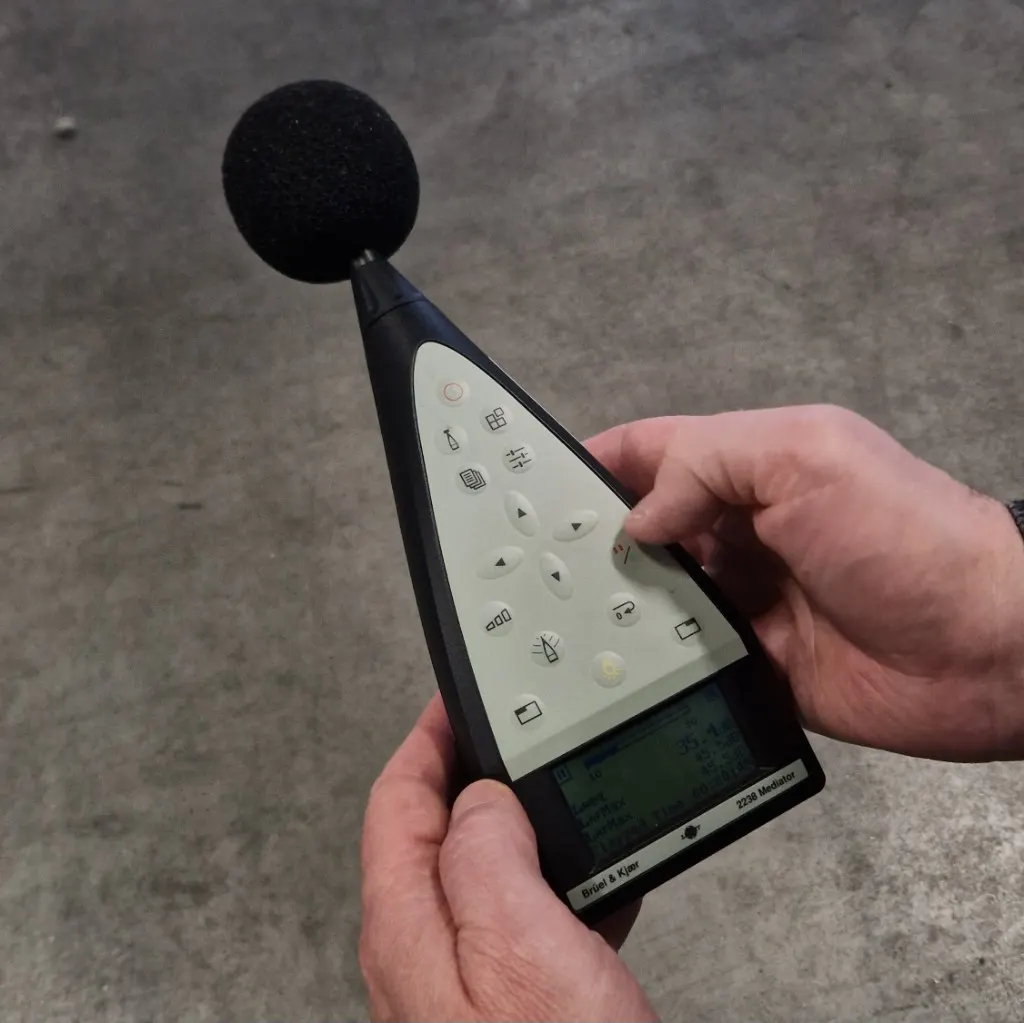
Noise measurement is one of the more underestimated aspects of CE marking for machinery. Manufacturers often discover only during acceptance testing at the end customer’s premises that their machine exceeds occupational exposure limits. This guide breaks down what noise data you are legally required to state in the instructions for use, the practical difference between sound power and sound pressure, and when it pays to measure noise in-house rather than calling in an expensive accredited laboratory.
Noise data the manufacturer must declare
The manufacturer of machinery is required to state information on airborne noise emissions in the instructions for use. This requirement is set out in Directive 2006/42/EC on machinery and is carried over unchanged into Regulation (EU) 2023/1230 on machinery, which will apply in full from 20 January 2027.
The declaration requirements are graded according to the A-weighted emission sound pressure level (LpA) at the workstation.
Up to 70 dB(A)
Where the A-weighted emission sound pressure level at the workstation does not exceed 70 dB(A), the manufacturer does not have to state a specific value. The instructions should simply state that this level does not exceed 70 dB(A).
Above 70 dB(A)
Where the A-weighted emission sound pressure level at the workstation exceeds 70 dB(A), its measured value must be stated.
Above 80 dB(A)
Where the A-weighted emission sound pressure level at the workstation exceeds 80 dB(A), the manufacturer must also state the A-weighted sound power level (LWA) emitted by the machinery, in addition to the sound pressure value.
Exception for very large machinery
In the case of very large machinery, where determining the A-weighted sound power level is not practical or technically feasible, the A-weighted emission sound pressure levels measured at specified positions around the machinery may be indicated instead.
Peak C-weighted sound pressure
Where the peak C-weighted instantaneous sound pressure value (LpC,peak) at the workstation exceeds 63 Pa, equivalent to 130 dB in relation to the reference value of 20 µPa, this value must also be stated.
How the declared values are established
The declared noise values may be either:
- actually measured on the machinery in question, or
- established on the basis of measurements taken on technically comparable machinery representative of the product type.
The measurement procedure draws on the general standards EN ISO 11201/11202/11204 (sound pressure) and EN ISO 3744/3746 (sound power). For specific machine types, additional standards may exist that specify the measurement positions and conditions. Where no specific standard exists for a given machine, the noise must be measured using suitable equipment and the method most appropriate to that machine. For such cases the directive sets a fallback rule: measure at a distance of 1 m from the surface of the machine and at a height of 1.6 m above the floor. The measurement uncertainty, the operating conditions during measurement and the method used must always be stated.
Sound pressure and sound power
Sound power expresses how much acoustic energy a machine produces. One way to picture it is to enclose the entire machine in an imaginary envelope (a box, say) and observe how much sound energy passes through that envelope.
Sound power is denoted LW and is usually determined by calculation from sound pressure measurements.
Sound pressure (Lp), by contrast, is what matters most with machinery. It describes the noise at a particular point relative to the machine. Stand 10 m away and the measured sound pressure will be lower than at 1 m. The sound power produced, however, remains the same.
As noted above, where the measured A-weighted emission sound pressure level does not exceed 80 dB(A), the manufacturer does not have to declare the sound power.
A-weighting
A-weighting simulates the sensitivity of human hearing, because what concerns us is less the exact physical value of the noise than its effect on people.
You can picture A-weighting as a curve describing how the human ear perceives individual frequencies. At low frequencies it subtracts tens of decibels from the measured value, because people perceive low tones far less sensitively. At the mid and higher frequencies, where hearing is most sensitive, the attenuation is much smaller.
The resulting values are therefore given as:
- LpA for sound pressure,
- LWA for sound power.
These appear routinely in measurement reports and instructions for use. A value of 80 dB(A), for example, means that A-weighting was applied during measurement.
C-weighting
C-weighting accounts for the change in the sensitivity of human hearing at very high sound levels and is used mainly to assess extreme noise and instantaneous peaks, such as the strike of a press or bursts of compressed air.
You can picture C-weighting as a much flatter curve. At low frequencies it subtracts almost no decibels from the measured value, because at deafening levels people begin to perceive low tones very intensely and even feel them physically. The filter passes almost all of the raw acoustic energy across the entire frequency range, ensuring that the calculation does not underestimate the real mechanical and destructive force of the pressure wave acting on the eardrum.
For the peak C-weighted sound pressure level, the notation LpC,peak is used. A value of 130 dB(C), for example, means that C-weighting was applied when measuring peak noise.
The risks of machinery noise
According to research published on ScienceDirect, exposure to noise above 85 dB for as little as 5 hours a week can cause permanent hearing damage. Directive 2003/10/EC therefore requires that, once average workplace noise reaches the lower exposure action value of 80 dB(A), or peak impulsive noise exceeds 135 dB(C), hearing protection must be made available to workers. From the upper exposure action value of 85 dB(A) (or a peak of 137 dB(C)), wearing it becomes strictly mandatory. The machine manufacturer must clearly reflect these facts in the instructions for use.
Although standard industrial hearing protection (earmuffs or plugs) can realistically attenuate 20 to 35 dB(A), in the hierarchy of controls, prescribing personal protective equipment is the last resort. The designer’s priority should always be to reduce the noise of the machine itself. Hearing protection must never be an excuse for a noisy design.
While in-house measurement is sufficient for the declaration of conformity, your customer, wherever in the world they operate, will be required by local authorities to engage an accredited laboratory to assess the workplace under real conditions. The laboratory’s technician will start by taking your declared values as the reference. If worse values are measured on site, the problem comes back to the supplier, and the customer will typically demand immediate additional noise mitigation at your expense. If the machine is older and has not been maintained in line with the operating manual, say through increased vibration from inadequate lubrication, worn bearings or other faults, you may have grounds to push back. Even there, however, limits apply, and any such claim must be substantiated.
In-house vs. external measurement
When assessing conformity and preparing the technical documentation, the manufacturer faces a choice: measure the machine’s noise emissions in-house, or commission an external accredited laboratory. It is worth being clear about the legal reality up front: neither the Machinery Directive nor the new Machinery Regulation requires noise measurement for the purposes of the declaration of conformity to be carried out by an accredited laboratory. The manufacturer is fully entitled to declare these values on the basis of its own in-house measurement.
The decision on which route to take should depend on available personnel capacity and, above all, on the production model.
Series production (large volumes of identical machines)
If you build machines in series, you typically measure noise only a few times a year, usually while developing and approving a new prototype. Here it is far more cost-effective to use an external laboratory. A one-off fee for a professional site visit is more economical than investing in your own sound level meter and acoustic calibrator and then tracking and paying for their regular calibration.
Special-purpose machinery (one-off production)
The opposite is true if you develop and build special-purpose machines or unique lines. Every project is one of a kind, and noise has to be measured afresh for each order. With a high number of tests, repeatedly calling in external technicians would make production prohibitively expensive. In this setup it clearly pays to build up in-house measurement capability. Given the frequency of testing, the investment in your own equipment pays for itself very quickly.
Sources
- Directive 2006/42/EC of the European Parliament and of the Council on machinery
- Regulation (EU) 2023/1230 of the European Parliament and of the Council on machinery
- Directive 2003/10/EC on the exposure of workers to noise
- ScienceDirect — Noise-Induced Hearing Loss
- EN ISO 11201 / 11202 / 11204
- EN ISO 3744 / 3746