Standard Designations for CE Marking: How to Make Sense of Them?
A designation like DIN EN ISO 13849-1 looks like a jumble of acronyms, but there is a clear system behind it. This article shows how to read it, how standards relate to CE marking and where to begin with your own machine.
There is a system to it
Prefixes are read from right to left, that is, from origin to you. Take DIN EN ISO 13849-1:
- ISO (or IEC) is the international level. The standard applies worldwide.
- EN means that a European standardisation organisation (CEN or CENELEC) has adopted it unchanged as a European standard.
- DIN means that, again unchanged, it has been adopted into the German national framework by Deutsches Institut für Normung.
The text is identical at every level of adoption, only the language and cover page change. If a national version contained technical deviations, it could not carry the EN ISO or DIN EN ISO designation. Such modifications are marked with the abbreviation MOD (modified adoption), and an explanation of the deviations is always given directly in the introduction of the standard concerned.
Several other combinations follow from this logic:
- DIN EN is a European standard. Either CEN created it from scratch, or it is a modified adoption of an ISO/IEC standard that has therefore lost the EN ISO or EN IEC label (as noted under MOD above).
- DIN EN IEC is a standard from IEC adopted via CENELEC.
- DIN ISO without EN is a standard from ISO adopted directly into the German framework that has not gone through European harmonisation.
- DIN on its own is a purely national German standard.
Parts: -1, -2 and so on
Larger standards are divided into numbered parts. Returning to our example, ISO 13849:
- -1 general design principles, Performance Level calculation
- -2 validation
Part -1 is, by ISO/IEC convention, usually reserved for the general foundation containing principles, terminology and methodology. Higher numbers then deal with specifics, whether testing methods, validation or sub-categories of machines. It is a convention rather than an absolute rule, but it holds in most cases.
The rule worth following is to go through the entire family of standards and find what is relevant for your machine. Sometimes one part is enough, sometimes you need to combine several together. With ISO 13849, you typically use -1 for design and -2 for validation as a pair. For other families, only one specific part may be relevant. The key is to know the family exists and to assess what you actually need.
Who writes the standards: ISO, IEC, CEN and CENELEC
Four organisations stand behind the standards, two international and two European.
ISO is the International Organization for Standardization, based in Geneva. It develops international standards across all fields except electrotechnology. As a memory aid: ISO covers mechanics and general engineering.
IEC is the International Electrotechnical Commission, also based in Geneva. It covers electrotechnology, electronics and related technologies. In short: IEC handles electrical matters.
CEN (Comité Européen de Normalisation, European Committee for Standardization) and CENELEC (Comité Européen de Normalisation Électrotechnique, European Committee for Electrotechnical Standardization) are their European counterparts. CEN does what ISO does within the European framework, CENELEC does what IEC does.
Which brings up the question: why have European versions when international ones already exist? The reason is both political and practical. The European Union needed unified standards across its member states for the single market to function. Rather than have CEN and CENELEC write everything from scratch, they signed cooperation agreements with ISO and IEC, namely the Vienna Agreement of 1991 and the Frankfurt Agreement. The principle is simple: when ISO or IEC produces a sound international standard, CEN or CENELEC adopts it unchanged as a European standard. CEN and CENELEC produce their own standards only where the EU addresses something specific, typically tied to a particular directive or regulation.
That is why the vast majority of standards you will encounter are designated EN ISO or EN IEC. International content with a European seal.
National bodies and which level carries what weight
That said, this is not the whole world of standardisation. Every country has its own national body, like DIN in Germany. The British have BSI, the Americans ANSI, the Japanese JISC. BSI EN ISO 13849-1 is exactly the same standard as DIN EN ISO 13849-1, simply in the British national framework.
The reach of each level differs in important ways:
- ISO and IEC apply worldwide, the layer with global reach and the broadest universal weight.
- CEN and CENELEC are relevant for the European market and CE marking. Outside Europe the EN prefix by itself carries no special weight. The value lies in the ISO or IEC content underneath.
- National bodies are essentially local distributors, translating and publishing international standards for their market.
Among national bodies, DIN deserves a particular mention. Germany has long been extraordinarily active in international standardisation, and a great many ISO standards on machinery safety have German roots or strong German participation in the technical committees. When you come across a German interpretation of a particular standard or a commentary by a German author, it often reflects the mainstream European view. Worth paying attention to.
The big picture: legislation and standards
Before picking a standard, it helps to understand how it fits into the whole.
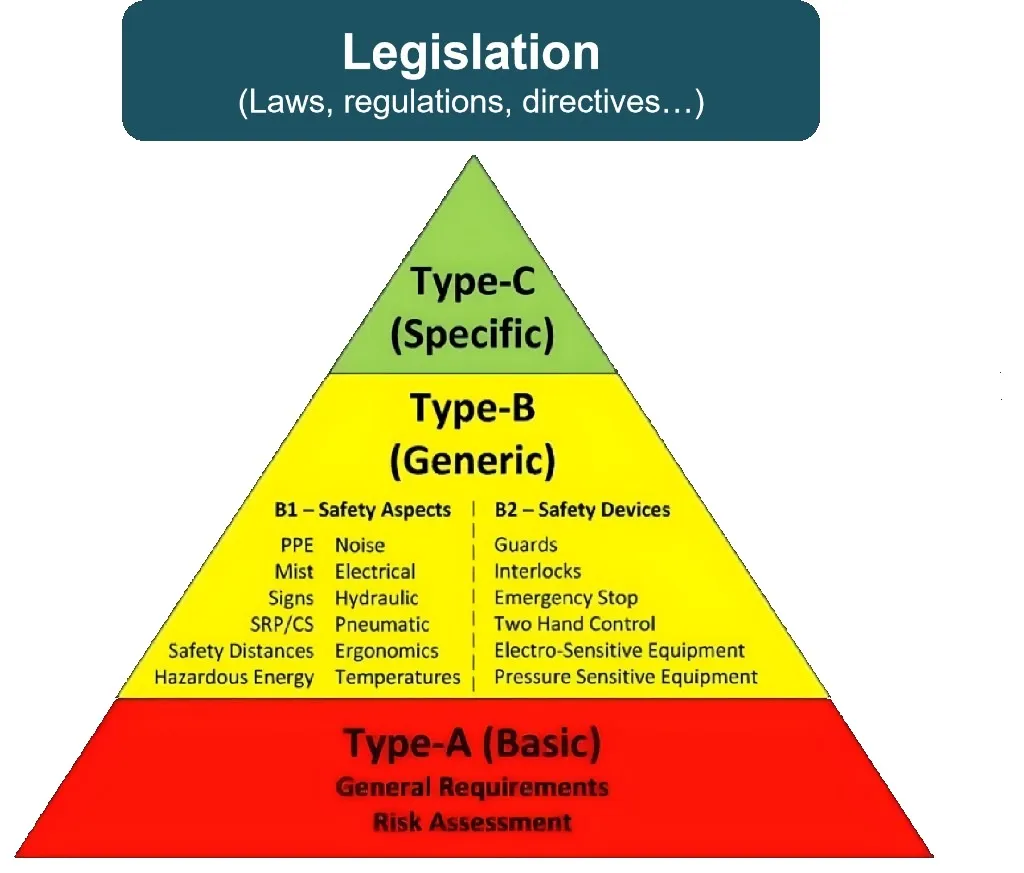
At the top sits the legislation, which in the machinery world means Directive 2006/42/EC and, from January 2027, Regulation (EU) 2023/1230. The legislation defines the essential health and safety requirements that every machine must meet to obtain CE marking. These requirements are general and applicable to all machinery. They say what, but not how.
Beneath the legislation sit harmonised standards. These are standards whose references the European Commission has published in the Official Journal of the EU as a recognised means of demonstrating conformity with a particular directive or regulation. They say how. If you build a machine in accordance with them, you obtain the presumption of conformity with the specific essential requirements that the standard covers. More on the presumption of conformity below.
In short: the directive or regulation is mandatory, while harmonised standards are a voluntary (and highly recommended) means of meeting it.
Type A, B and C standards, and where to start
Harmonised machinery standards have an internal hierarchy of their own, defined by ISO 12100. It expresses how general or specific a standard is. The scheme covers all machinery safety standards, both ISO and IEC. That is why standards like IEC 60204 or IEC 62061, which deal with the electrical or functional safety side of machinery, sit within it as well.
Type A
The foundation for all machinery. There is only one: ISO 12100, which defines risk assessment and the strategy for risk reduction.
Type B1: safety aspects
Generic standards covering a specific safety aspect that can apply across many machines. Examples:
- safety distances (ISO 13857)
- functional safety of control systems (ISO 13849, IEC 62061)
- electrical equipment of machinery (IEC 60204)
- noise, surface temperatures, ergonomics
Type B2: safeguards
Generic standards for specific protective devices. Examples:
- guards (ISO 14120)
- interlocking devices (ISO 14119)
- electro-sensitive protective equipment, e.g. light curtains (IEC 61496)
- pressure-sensitive protective devices (ISO 13856)
Type C
Standards for a specific machine or narrow group of machines, typically machine tools, presses or robots.
Precedence and workflow
In case of conflict, type C takes precedence over types B and A. The team that wrote the type C standard knew the technology in detail, and the standard tells you directly which type B standards you need and where to ground yourself in ISO 12100.
The design workflow then usually looks like this: check whether a type C standard exists for your machine. If it does, that is your primary guide, and it will lead you on to the necessary type B and A standards.
When no type C standard exists
For many special-purpose or unusual machines, there simply is no type C standard. This happens routinely and is no disaster, it just requires more work and judgement. The workflow:
- Start with ISO 12100, which will take you through the risk assessment and reduction methodology. That is your backbone.
- Identify the relevant type B standards, finding one for each identified hazard, whether for guards, distances, control systems or noise.
- Take a type C standard for a similar machine or component as inspiration. If your machine has a grinding station, reach for the type C standard for grinding machines. If it has a pressing unit, consult the standard for presses.
An important point: a standard for a similar machine serves as inspiration, not as a primary specification. Review it critically and document why you adopted or modified a particular solution.
Standards are voluntary, but…
This is the most common misconception. The use of a harmonised standard is voluntary. Regulation (EU) 2023/1230 states this in paragraph 48 of its introduction, and the same principle applied under Directive 2006/42/EC. Only the essential requirements set out in the legislation are mandatory. On the EU declaration of conformity you must therefore list the applied directives and regulations, while listing standards is technically optional.
The practice, however, is different. A declaration of conformity that lists no standards at all looks suspicious. From both a market surveillance perspective and a customer perspective, it suggests that either the manufacturer did not work with standards or is uncertain whether the standards were met. Listing the harmonised standards used is formally voluntary but is, in practice, an industry standard.
Why use them, then: the presumption of conformity
Because a harmonised standard is the most reliable path to demonstrating conformity. If you build a machine in accordance with a harmonised standard whose reference is published in the Official Journal of the EU, you are entitled to the presumption of conformity. The machine is presumed to meet the essential requirements that the standard covers. This stems from Article 7 of Directive 2006/42/EC and Article 20 of Regulation (EU) 2023/1230.
In practice this shifts the burden of proof. Without a standard you must independently justify that your solution meets the requirement. With a harmonised standard you lean on established consensus.
A detail worth watching: the presumption of conformity applies only to the specific edition of the standard whose reference is actually in the list of harmonised standards. Not every EN standard is harmonised, so verify your specific edition.
When to take your own route
Without a harmonised standard you can still demonstrate conformity, but the justification and the burden of proof are entirely on you. It makes sense in two situations:
- Technological constraint. The standard assumes a solution that does not physically make sense for your machine, and you have an equivalent safety measure.
- Economic constraint. Strict compliance would disproportionately raise costs for a marginal safety benefit. Here, keep first-class documentation, because the economic argument is the first thing market surveillance or a notified body will challenge.
In both cases, a risk assessment must be the starting point, clearly demonstrating an equivalent or higher level of safety.
Bonus: a bit of the world for free
A DIN EN ISO standard rests on the internationally recognised ISO text. A machine designed according to a sound DIN EN ISO standard is very likely to meet most requirements outside Europe as well, because those requirements largely build on the same ISO foundation.
It is not a guarantee. The US (OSHA, ANSI, UL), Brazil (NR-12) and other jurisdictions have their own specifics that need separate verification. But the starting position is markedly better than if the machine had been designed against a purely national standard.
Sources
- Directive 2006/42/EC of the European Parliament and of the Council on machinery
- Regulation (EU) 2023/1230 of the European Parliament and of the Council on machinery
- ISO 12100 – Safety of machinery, general principles for design
- Vienna Agreement on technical cooperation between ISO and CEN
- Frankfurt Agreement on cooperation between IEC and CENELEC
- List of harmonised standards under the Machinery Directive (European Commission)